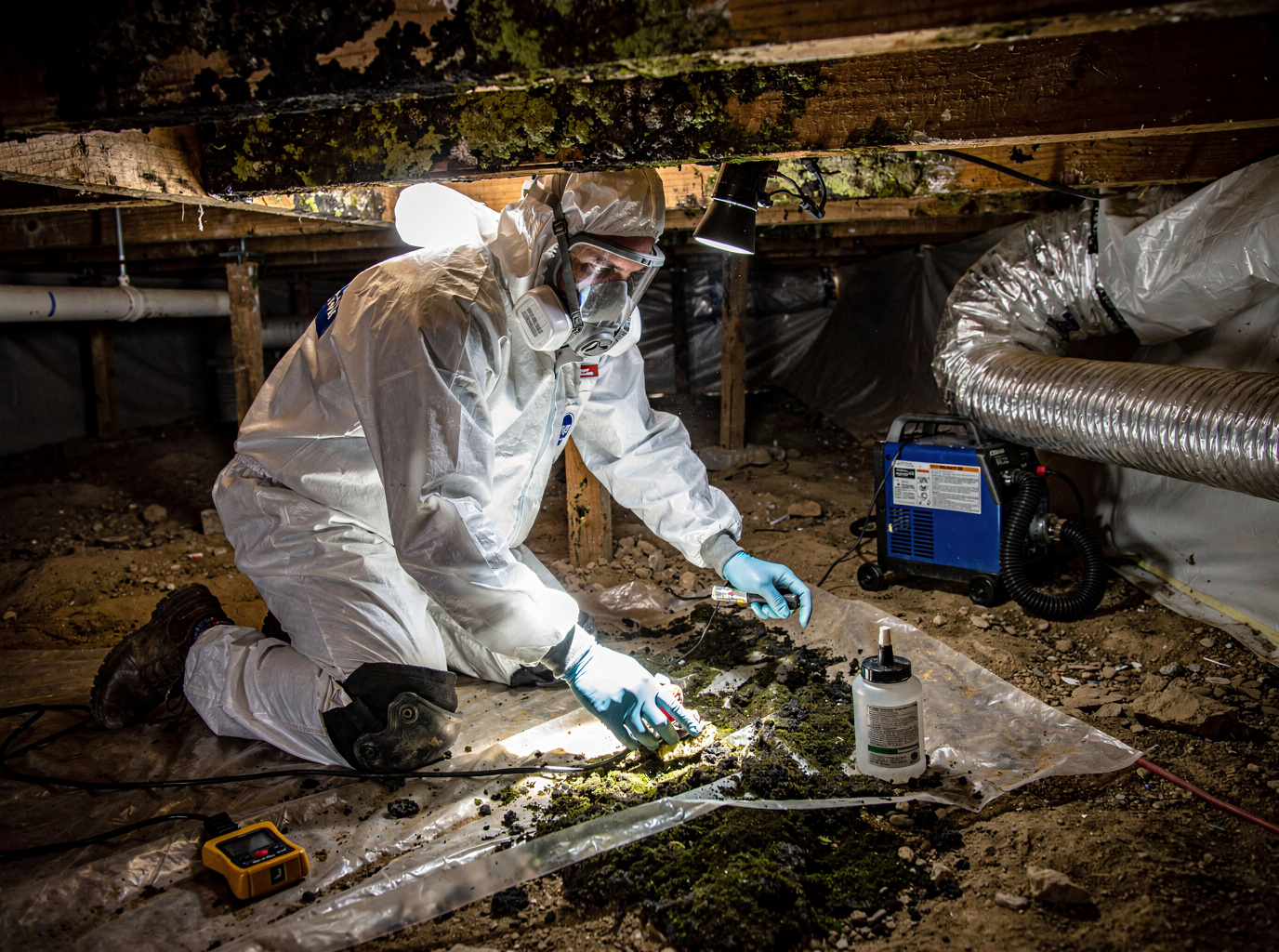
In Pinon Hills crawl spaces, mold often develops where cold winter nights meet warmer daytime air, creating condensation on joists and insulation in homes built on the area's sandy soils. Older ranch-style houses and manufactured homes common here frequently lack adequate vapor barriers, allowing ground moisture from the high desert terrain to rise and feed growth along the perimeter walls. Technicians must account for limited access points and the risk of disturbing settled dust that can spread through the structure when work begins.
Remediation starts with isolating the space using containment barriers and negative air machines to protect living areas above. Crews remove affected insulation and treat framing with EPA-registered antimicrobials suited to porous wood surfaces found in local builds. Drying follows with targeted dehumidification calibrated for the region's low humidity days that can accelerate or hinder moisture removal depending on the season.
After treatment, a new vapor barrier is installed over the soil and sealed at the foundation walls to cut off the primary moisture source typical in San Bernardino County properties. Final clearance testing confirms spore levels match outdoor baselines before the space is returned to service. Homeowners in nearby Phelan and Wrightwood often request the same approach due to similar elevation and climate patterns.
Regular inspections every spring after winter temperature swings help catch early growth before it spreads to subflooring. Ignoring minor odors or musty smells in these spaces can lead to larger structural concerns in the dry, expansive soils around Victorville and Pinon Hills.
Technician insight
In Pinon Hills, the thing that catches most people out with crawl space mold removal is how fast condensation builds on the underside of the floor during the first cold snap after a warm spell. Older homes near CA-138 often have no vapor barrier at all, so ground moisture from the sandy soil keeps feeding the mold even after you kill the visible growth.
Winter Condensation In A Pinon Hills Crawl Space
A homeowner in Pinon Hills noticed a musty smell after the first hard freeze. We found black mold along the rim joists where cold night air met warmer daytime temperatures. The crawl space had no vapor barrier and sat on open soil typical of the area. We removed the insulation, treated the framing, installed a sealed liner, and the odor was gone within a week.
Crawl Space Mold Removal Services We Offer
✓Crawl Space Mold Inspection
Detailed visual and moisture meter assessment of joists, insulation, and soil in Pinon Hills crawl spaces to locate hidden growth before it affects indoor air.
✓Moisture Source Identification
Tracing leaks, poor drainage, and condensation patterns common in high desert winters that feed mold along foundation walls in San Bernardino County homes.
✓Containment and Negative Air Setup
Installation of sealed barriers and HEPA filtration systems to prevent mold spores from migrating into living areas during removal work.
✓Insulation Removal and Disposal
Safe extraction and disposal of contaminated fiberglass or cellulose from crawl spaces where temperature swings accelerate mold on older Pinon Hills properties.
✓Antimicrobial Treatment
Application of EPA-registered products to treated wood and concrete surfaces after mold removal to inhibit regrowth in humid microclimates.
✓Vapor Barrier Installation
Sealing crawl space soil with heavy-duty liners taped at walls to block ground moisture typical of the sandy terrain around the Pinon Hills Community Center.
How it works
- 1
Initial Assessment
Technician enters the crawl space from the exterior access point to map moisture readings and visible mold on joists and insulation.
- 2
Containment Setup
Plastic sheeting and negative air machines isolate the work area from the home interior and garage.
- 3
Removal And Treatment
Affected materials are removed, surfaces are cleaned, and antimicrobial solution is applied to framing.
- 4
Drying And Barrier Install
Dehumidifiers run until wood moisture content stabilizes, then a new sealed vapor barrier covers the soil.
- 5
Clearance Check
Air sampling confirms spore counts before the space is released for normal use.
Pricing
Cost depends on square footage of the crawl space, depth of mold, and whether insulation must be replaced.